
Artikeln har lagts till i varukorgen
Artikeln har lagts till i varukorgen
Malmö universitet
Ny bok | Häftad
Läs mer om olika typer av bindningar här.
LEVERANS: Skickas inom 6-14 vardagar.
LEVERANS: Vi skickar din beställning med Postnords Varubrev eller DHL Servicepoint.
Du betalar alltid endast 49 kr i fraktavgift inom Sverige, oavsett vikt eller antal böcker vid beställning av antikvariska och nya böcker från oss! Läs mer
Det gick inte att ladda hämtningstillgänglighet
ENDAST 49 kr i fraktavgift inom Sverige, oavsett antal böcker!
Du betalar alltid endast 49 kr i fraktavgift inom Sverige, oavsett vikt eller antal böcker vid beställning av antikvariska och nya böcker från oss! Läs mer
ÅNGERRÄTT inom 14 dagar efter leverans.
RETUR & ÅNGERRÄTT: Du har alltid 14 dagars ångerrätt oavsett anledning, från den dagen du tar emot din leverans.
Skulle vår beskrivning av skicket på boken misstämma eller om vi på annat sätt gjort fel, står vi självfallet för returfrakten.
I KORTHET: Utforska hur kemisk utbildning kan formas av Anthropocene för att möta samtida miljöutmaningar och främja hållbarhet.
Denna bok erbjuder en djupgående analys av kemiundervisning i en tid präglad av miljöutmaningar. Riktad till lärare och studenter inom pedagogik, bjuder den på insikter om hur kemi kan kopplas till hållbarhet och etik. Du får verktyg att tänka kritiskt kring ämnet och dess roll i samhället. En viktig läsning för framtida utbildare!
The urgent and contemporary challenges of the Anthropocene declare humanity’s vulnerability through complex entanglements and uncertainty. The cause-and-effect relationships and temporality are disturbed; and human-decentred views and materiality come to the fore. Consequently, it becomes challenging to find a “common answer” for how to educate. This thesis engages with this challenge as a prospective-generating project and adopts the concept of Anthropocene as a framing in science education research. More specifically, this thesis focuses on school chemistry content and science teachers. The overarching aim of this thesis is to problematise school chemistry knowledge through the perspective of the Anthropocene. The ambition is to create knowledge about school chemistry knowledge when it is situated in the intersection of content, purposes, and relationships, framed by the challenges of the Anthropocene. Therefore, approaches to school chemistry knowledge in the Anthropocene were explored in this research. This overarching aim is addressed through two research purposes. These research purposes are addressed in four individual studies. Each study has its own theoretical and analytical focus and its own set of research questions. The first purpose is to theoretically elaborate desired school chemistry knowledge areas (Articles I and II). The second purpose is to empirically study how school chemistry knowledge is articulated from (becoming) practitioners’ perspectives when challenged by the Anthropocene (Articles III and IV). To address the first research purpose, school chemistry knowledge areas were problematised in relation to Environmental and Sustainability Education (ESE) and the Anthropocene in two theoretical studies. The theoretical grounding for these studies is the European continental didaktik tradition as well as related powerful knowledge discussions. In Article I, a theoretical didaktik model was developed whilst embedding chemistry education into ESE. Schools are seen as part of society embedded in contemporary global challenges. Emphasizing teachers’ centrality in engaging with didactic questions of why, what, and how, the study proposes a holistic approach to chemistry education with critical perspectives. Building on the first study, Article II adopted the Anthropocene as a challenging framing and perspective regarding chemistry education more generally. By utilizing the discussion of powerful knowings and posthuman Bildung, the article discusses what ChemoKnowings and other SubjectKnowings might mean in relation to the Anthropocene, through the development of didaktik models. One of them is a vision-oriented model to mobilise students’ ethico-socio-political thinking and action. In relation to the second research purpose, empirical studies were conducted from the perspectives of practitioners, namely, experienced chemistry teachers (Article III), and (general) science (“naturkunskap”) teacher students oriented towards upper secondary school (Article IV). While theoretical foundations for these empirical studies were grounded on European continental didaktik, each study has its own analytical lens. Article III explored experienced chemistry teachers’ approach to knowledge when the Anthropocene and the vision-oriented model developed in Article II were the points of departure. The analyses showed that school chemistry knowledge can be a means for teachers to regulate negative emotions associated with the challenges of the Anthropocene. Therefore, solutions to the environmental and sustainability issues were viewed as part of “putting chemistry content on the table”. The teachers viewed school chemistry knowledge as a prerequisite and foundation for students’ awareness and engagement with environmental and sustainability issues. In the article, these results were further discussed in relation to taken-for-granted assumptions on chemistry education and selective traditions. In Article IV, the focus was on the “fresh eyes” of science teacher students. The article explored teacher students’ discussions of future science teaching in the light of the Anthropocene after receiving a lecture on it in a teacher education course. Focus group discussions of science teacher students were analysed with Latour’s “matters of concern” as an analytical lens. Results mainly showed that the shared input of the Anthropocene urged them to express matters of concern whilst adopting a personal and everyday-oriented perspective. On the other hand, they also assumed the role of future professional teachers and approached educational content as matters of concern. Implications for science teacher education were also discussed. The thesis further synthesizes theoretical perspectives and empirical findings. Through theoretical reasoning and knowledge gained from the empirical material, chemistry education is envisioned, urging a transformation from “matters of fact” to “matters of concern”.
Bindning: Häftad. 8:o (170x244 mm)År: Utg. 2024. Omfång: 218 s. ISBN: 9789178775125. Språk: Engelska
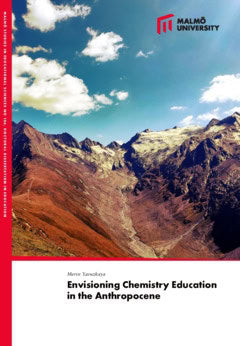
Författare: Yavuzkaya, Merve
Titel: Envisioning chemistry education in the anthropocene
Förlag: Malmö universitet
Genre: Kemi
Artikelnr: 33941246
Envisioning chemistry education in the anthropocene av Merve Yavuzkaya hittar du under genren Elektricitet & magnetism inom Kemi i kategorin Natur, vetenskap & teknik. Hitta fler liknande böcker:

Skönlitteratur i svenska skolor handlar inte bara om underhållning utan erbjuder en kraftfull pedagogisk källa. Genom att utveckla empati, etisk medvetenhet och kritiskt tänkande, stärker litteraturen elevernas förståelse för samhällets...
Skönlitteratur i svenska skolor handlar inte bara om underhållning utan erbjuder en kraftfull pedagogisk källa. Genom att utveckla empati, etisk medvetenhet och kritiskt tänkande, stärker litteraturen elevernas förståelse för samhällets...

Upplev Sylvia Plaths fascinerande värld där personlig turbulens möter konstnärligt skapande. Utforska hennes poetiska arv, genomsyrat av teman som död, identitet och depression, och upptäck hur hennes livserfarenheter formade litteraturhistorien.
Upplev Sylvia Plaths fascinerande värld där personlig turbulens möter konstnärligt skapande. Utforska hennes poetiska arv, genomsyrat av teman som död, identitet och depression, och upptäck hur hennes livserfarenheter formade litteraturhistorien.

Julia Quinn, mästaren bakom Bridgerton-serien, har revolutionerat romancegenren genom att smälta samman historisk exakthet med modern relevans.
Julia Quinn, mästaren bakom Bridgerton-serien, har revolutionerat romancegenren genom att smälta samman historisk exakthet med modern relevans.

Upplev en gripande och poetisk resa i Niels Fredrik Dahls roman Fars rygg, där ensamhetens tyngd och identitetens sökande utforskas genom komplexa relationer mellan far och son. Boken balanserar melankoli...
Upplev en gripande och poetisk resa i Niels Fredrik Dahls roman Fars rygg, där ensamhetens tyngd och identitetens sökande utforskas genom komplexa relationer mellan far och son. Boken balanserar melankoli...
